Archibald Purves and Elizabeth Cosser - Roots in the Coldingham Soil
Seven Ill Years: The dawn of the Purves dynasty in the Scottish Borders did not rise in warmth or prosperity, but was forged in the bitter frost of the late 17th century. When Archibald Purves and Elizabeth Cosser stood before the Coldingham Kirk to be married in 1698, the entirety of Scotland was groaning under the weight of the “Seven Ill Years.” It was a decade defined by catastrophic harvests, relentless freezing winds, and sweeping famine. To establish a household during this era required a profound, iron-willed resilience. Archibald and Elizabeth did not just survive this bleak turning of the century; they planted a family tree deep into the heavy Berwickshire soil that would weather the next three hundred years.
The Hearth at Northfield Their universe centred entirely around Northfield, a rugged agricultural settlement within the coastal parish of Coldingham. The Purves family home was not a place of comfort by modern standards, but a fortress against the elements. It would have been a traditional Borders cot-house—a low, narrow dwelling built from unhewn fieldstone, its walls packed thick with clay to block the whistling sea gales.
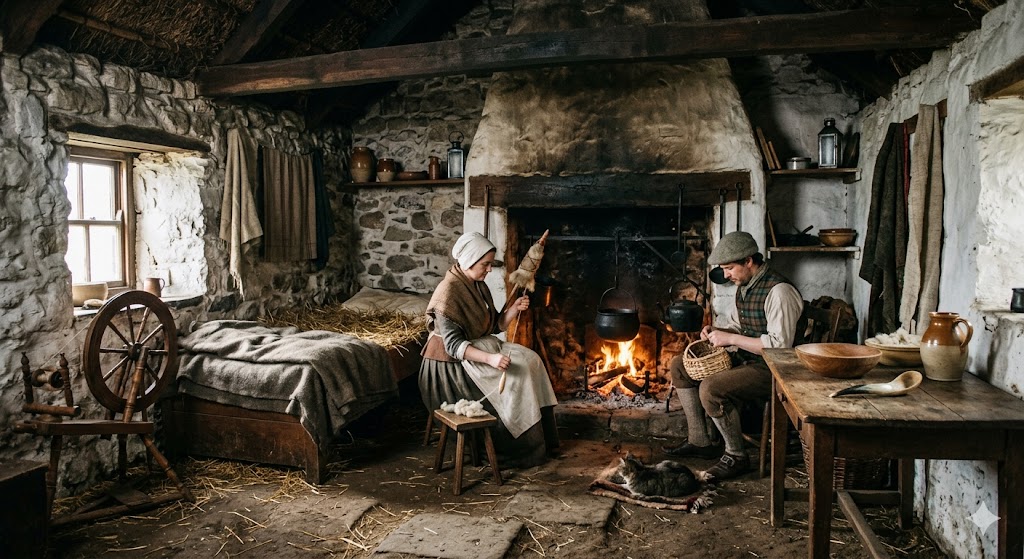
Inside, the sharp, earthy scent of a peat fire burning on an open central hearth defined the home. This fire was the absolute lifeblood of the family, providing the only source of heat and the dim light by which Elizabeth performed her gruelling daily chores. It was a life of constant motion: spinning coarse wool, fetching water, and endlessly preparing heavy, monotonous meals of oat pottage, tough kail, and bere barley to keep the cold from her family’s bones.
The Runrigs and the Coastline To feed their growing family, Archibald’s life was tied to the unforgiving earth of the Northfield estate. But the Purves family did not work for just any local laird; they were tenant farmers under the Honourable Lord Kames, a towering figure of the Scottish Enlightenment and a pioneer of the British Agricultural Revolution.
Long before the land was meticulously measured and enclosed, Archibald and his sons worked fields with names Blakeward, Greenland, and Tunley Bank using the ancient, communal “runrig” system. Working side-by-side with their neighbours on narrow, alternating ridges, they wrestled with primitive wooden ploughs pulled by oxen, trying to coax life out of the cold, coastal dirt. They could not have known that within a century, Lord Kames would have surveyors mapping every rood and perch of those very fields to dismantle the old ways forever.
But the earth was not the only master in Coldingham; there was always the sea. To supplement the meagre income of the farm, the men of Northfield frequently turned to the treacherous, jagged cliffs bordering the eastern edge of the estate. They scaled the sheer rocks to harvest kelp for fertiliser, catch fish, or gather seabird eggs. It was a dangerous, vital dance with nature that would ultimately change the family forever.
A Crowded Cot-House The true testament to Archibald and Elizabeth’s strength was the sheer scale of the family they raised around that peat fire. In an era where infant mortality was devastatingly high, the Purves household bustled with life. Between 1699 and 1718, they welcomed at least eleven children into the world.
The cot-house would have echoed with the constant noise of Jane, Alexander, Elizabeth, Francis, Agnes, George, Archibald, John, Charles, Isabella, and James. Raising such a massive brood meant every hand was eventually put to work on Blakeward and Greenland. Young Francis—the boy who would eventually carry the direct line forward—learned early that survival required the labour of the entire family.
The Fall By 1730, Archibald had lived a remarkably full life for the era. He was a grandfather, having successfully raised his enormous family through Scotland’s hardest years. Yet, the demands of survival never truly ceased. Sometime that year, the elderly patriarch ventured out to the Coldingham cliffs. In a sudden, violent turn of fate, Archibald lost his footing.
The Kirk Session recorded the devastating event with blunt, heartbreaking clarity: he “happened to fall from the rocks into the sea & perished amongst the waves.” The North Sea swallowed the founding father of the Purves line. It was a brutal, tragic end to a life defined by hard work and resilience. Yet, the foundation he and Elizabeth had built at Northfield was unshakeable. He left behind a legion of sons and daughters—including Francis—who were already turning the earth, tending the hearths, and ensuring that the Purves name would endure long past the man who first brought it out of the frost.
Francis Purves - The Mortcloth and the Missing Matriarch
The Heir to the Heavy Earth When Francis Purves was baptized in the early summer of 1706, the harsh memories of the “Seven Ill Years” were still fresh in the minds of the Coldingham parish. As the second eldest son in a sprawling household of eleven children, Francis’s childhood at Northfield was defined by the rhythm of the runrigs and the unforgiving bite of the North Sea winds. He grew up knowing nothing but the brutal, honest labour of coaxing life from the Berwickshire soil. As he stepped into adulthood in the 1730s, Francis took up his father’s mantle, continuing the Purves legacy as a man of the land.
Sons of the Soil Together, Francis and his wife began to fill their stone, thatched cot-house with children. Following strict, respectful Scottish naming traditions, they welcomed their first son, Archibald, in August 1737, honouring Francis’s father. Less than two years later, in the late spring of 1739, their second son—your direct ancestor, William—was baptized.
William’s arrival, proudly witnessed by fellow farmhands living at Northfield, secured the branch of the family that would eventually lead to you. But the quiet joys of these early years were soon overshadowed by the fragile reality of 18th-century life.
In the year 1740, the family welcomed a third son, naming him Francis after his father. But the triumph of his birth was agonizingly brief. Infant mortality was a devastating, ever-present spectre in the damp, drafty cottages of the Scottish Borders. A sharp frost, a failing harvest, or a sudden, sweeping fever could claim a child with terrifying speed.
On September 16, 1740, the Purves family endured the ultimate heartbreak. They were forced to approach the Coldingham Kirk Session not for a joyous baptism, but to pay the solemn fee to rent the “little mortcloth.” This heavy, black velvet pall, owned by the church, was draped over the tiny coffin of baby Francis as he was laid to rest in the kirkyard. It was a crushing blow, and an agonizing reminder of the razor-thin line between life and death in rural Scotland.

Quiet Endurance
Despite the heavy, lingering grief of 1740, Francis and his unnamed wife carried on—they simply had no other choice. The land still demanded to be ploughed, the hearth still needed tending, and their surviving boys, Archibald and young William, needed to be fed. In the years that followed, the cottage echoed with new life once again, welcoming Agnes in 1743 and John in 1746.
Through unimaginable loss and backbreaking labour, Francis and the missing matriarch held the family together. They ensured that William survived the perilous, vulnerable years of his childhood, raising the boy who would eventually stand before the Kirk himself, ready to carry the Purves name forward into a new era.
Historical Note: The Scottish Mortcloth (Click to read more)
A mortcloth (from the Latin word mors, mortis, meaning ‘death’) was a form of pall, that is, a large cloth (usually black) thrown over a coffin or corpse at a funeral. Mortcloths were kept by kirk sessions (church courts in each parish). Some were more elaborate than others, and a wealthier parish might have more than one (including a small one for corpses of children). They were hired, usually by the family or next of kin of the deceased, to cover the coffin (if a coffin could be afforded), or the corpse itself (if a coffin could not be afforded).
As the kirk session was responsible for poor relief until 1845, it might allow use of a mortcloth without charge, if the deceased or his family were paupers. For example, an act of the kirk session of Penicuik records that a velvet mortcloth was purchased in 1670 for £192 and 19 shillings Scots, and that those who contributed to the cost were allowed use of it for free.[1] Otherwise, it was hired out for 2 shillings and 6 pence Scots for burials in the parish, and 40 shillings Scots for burials outwith the parish.
In the 18th and 19th centuries, some people formed or joined friendly societies, paying subscriptions which paid for future funeral expenses. For example, the rules of the Haddington Mortcloth Society, 1833, survive in the National Records of Scotland.[2]
References to payments for mortcloths (along with payments for coffins or digging the grave of named persons) may appear in kirk session minutes and accounts, heritors’ minutes or accounts, or old parish registers. By recording a payment for a mortcloth, these may provide the approximate date of death of the corpse. These can be a substitute when burial records are missing or were not kept but reading through minute books and accounts of kirk sessions and heritors can require a lot of research time, often with little reward.
William Purves and Catherine Johnstone - The Cautioners
The Shadow of the Cliffs By the spring of 1772, William Purves was thirty-three years old and thoroughly shaped by the heavy earth of Northfield. He was a man of the land, but the history of the Purves family was inextricably, and tragically, tied to the neighbouring sea.
Although William had never met his grandfather, the founding patriarch Archibald the elder, the story of his demise cast a long, sobering shadow over the family. In 1730, years before William was even born, the elder Archibald had sought to supplement the family’s meagre farming existence on the treacherous Coldingham coastline. Tragedy struck when the patriarch fell from the jagged rocks, perishing amongst the unforgiving North Sea waves. The sea had swallowed his grandfather, serving as a brutal, generational reminder of the coastline’s dangers. It was perhaps this very trauma that bound William and his brothers so fiercely to the relative safety of the runrigs and the soil.

Booking the Names Life and the turning of the seasons demanded that the family endure. On April 5, 1772, William stood before the Coldingham Kirk Session to take a wife. He and Cathran (Catharine) Johnstone “booked their names in order to marriage,” confirming that both were well-established residents of the parish.
This was a deeply public and serious community milestone. By paying their fees and recording their intent, they initiated the reading of the banns—the proclamations read over consecutive Sundays by the minister to ensure there were no moral or legal impediments to their union before God and their neighbours.
The Bond of Brothers In 18th-century Scotland, no couple stood alone. The Kirk required them to provide “Cauts,” or cautioners—men of standing who acted as financial and moral guarantors for the marriage.
For Catherine, a man named John Johnston stepped forward as her cautioner, firmly representing her family’s blessing.
For William, the man who stood beside him was Archibald Purves. This was not the ghost of his grandfather, nor his late uncle who had passed in 1743, but his own older brother. With their father Francis either having passed away or grown too frail to fulfill the duty, the mantle of the family had passed to the eldest son.
It is a profoundly moving image of brotherly solidarity: Archibald, bearing a name heavy with the family’s tragic history, standing as the protector and sponsor for his younger brother. By acting as William’s cautioner, Archibald ensured the Purves line would continue safely on solid ground.
Deepening the Roots With the cautioners’ bonds paid and the proclamations read according to order, William and Catharine were formally wed. They did not leave the parish; they built their life together securely anchored to the Northfield estate. A decade later, their roots in the Berwickshire soil proved as strong as ever when they welcomed their son, David, into the world. Through devastating tragedy, unbroken brotherhood, and the steady turning of the seasons, the Purves dynasty held its ground.
Historical Note: What is a Cautioner? (Click to read more)
In Scottish genealogy and old church records, a cautioner (pronounced kay-shuner) was a friend, relative, or sponsor who pledged a financial bond or security to the church. This person guaranteed that there were no legal or moral impediments to the marriage and that the couple would fulfill their vows.
Purpose and Role of a Cautioner:
- Financial Guarantee: Deposited a monetary pledge (called a “caution”) with the session-clerk to prove the seriousness of the marriage intentions.]
- Proof of Freedom: Acted as a guarantor that neither person was already married and that the bride was not hiding a pre-existing pregnancy out of wedlock.
- Penalty Coverage: Ensured that if the engagement or marriage contract was broken, the church could claim funds to use toward local parish needs and the poor.
David Purves and Janet Hogg - Beyond the Parish Boundaries
The Turning of the Century For over a hundred years, the Purves family had been tethered to the heavy earth of Northfield. Through famine, the loss of children, and the ever-present danger of the North Sea, generations had lived, worked, and died within the boundaries of the Coldingham parish. But as the 18th century gave way to the 19th, the rigid structures of rural Scottish life began to shift.
David Purves, born to William and Catharine in the winter of 1782, came of age in a slowly modernizing world. The old, communal “runrig” system of farming was being aggressively dismantled, replaced by strictly enclosed fields and more efficient agricultural practices. With these changes came a new reality for the men and women of the Scottish Borders: to find work and sustain a family, one had to be willing to follow the shifting tides of labour.
A New Horizon in Chirnside David was the first in his direct line to step away from the Coldingham soil to begin his own family. His journey for work led him inland, where he crossed paths with Janet Hogg. The looping, flowing script of the parish registers captures the beginning of their life together: on January 19, 1807, David and Janet were married in the neighbouring parish of Chirnside. This union marked a quiet but profound milestone in the Purves history, breaking a century-old tradition of his ancestors booking their names under the authority of the Coldingham Kirk.
The Hedger of East Press However, the pull of the ancestral parish remained strong. In the early years of their marriage, David and Janet moved back into the borders of Coldingham, settling at the agricultural estate of East Press.

Here, David found his place in the changing landscape. The 1811 parish records list his occupation as a “Hedger.” As the great estates enclosed their lands, David was the man tasked with planting, bending, and laying the miles of hawthorn hedges that would redefine the Berwickshire countryside. It was highly skilled, blisteringly hard work, out in the elements from dawn until dusk.
It was at East Press that the couple welcomed their son, James, born on December 5, 1811. When James was baptized just a few weeks later, the tight-knit nature of the rural workers was on full display. The witnesses included a local vintner and a fellow farmhand named Robert Cossar—a subtle, beautiful echo of the Purves family’s founding matriarch, Elizabeth Cosser, proving that while times were changing, the old parish bloodlines still endured.
The Road to Cockburnspath The life of an agricultural worker was inherently transient, dictated by seasonal contracts and the availability of farm tenancies. Sometime between the birth of James in late 1811 and the spring of 1814, David and Janet packed their belongings and moved again. This time, they travelled roughly twelve miles north to Cockburnspath, a coastal parish where the rolling Lammermuir Hills met the dramatic cliffs of the North Sea.
The Next Generation It was in this new landscape that the next vital link in the Purves dynasty was forged. On the 17th of April, 1814, David and Janet registered the birth of their son, William.
Following the ancient Scottish tradition of honouring the paternal grandfather, the boy was named after the man who had stood before the Coldingham Kirk decades prior. Young William’s baptism cemented the family’s place within their new community. As David and Janet looked down at their infant son in the spring of 1814, they could not have known the legacy they were carrying forward. Young William represented a bridge between two worlds: he was the product of a deeply rooted, resilient agricultural past, and the patriarch-to-be for a family that would soon navigate the rapid changes and vast opportunities of the 19th century.
William Purves and Euphemia Bertram - The Grieve of Seton Mains
The Fatherless Years When David Purves was laid to rest under the Ayton mortcloth in the spring of 1815, his widow, Janet Hogg, faced an unimaginably daunting future. Left entirely alone with three-year-old James and one-year-old William, Janet was thrust into the grueling reality of 19th-century widowhood. Without her husband’s skilled income as a hedger, she had to rely on sheer, unrelenting resilience to keep her boys fed and clothed.
While the parish registers are silent on the daily struggles of Janet’s household, the survival of her sons speaks volumes. She raised two strong, capable men who would both go on to secure their own footing in the world. James eventually returned to the ancestral soil of Coldingham, but young William’s path would lead him entirely out of Berwickshire, charting a new course for his branch of the family.
North to East Lothian Coming of age in the 1830s, William left the borders and travelled north into Haddingtonshire (modern-day East Lothian). The agricultural landscape here was rich, deeply established, and hungry for strong labourers. It was here that William met Euphemia Bertram. Born in the Berwickshire parish of Whitsome, Euphemia shared William’s borders roots, though her father, Andrew Bertram, was a farmer himself.
While the Kirk did not record their wedding banns—a frequent casualty of missing parish ledgers or irregular marriages—the couple was officially established by the time the 1841 census enumerators knocked on their door. Living in the parish of Gifford, twenty-five-year-old William was working as an Agricultural Labourer, supporting Euphemia, their two-year-old daughter Alice (Allison), and five-month-old David. By 1851, the family had grown to include a second son, Andrew, and they remained anchored in Gifford, working the East Lothian soil.
The Ascent of William Purves The story of a 19th-century agricultural worker is typically one of static, lifelong physical labour. But William Purves was not a typical labourer. As the decades progressed, the census returns reveal a remarkable career trajectory for the fatherless boy from Cockburnspath.
Sometime before 1861, William moved his family to Seton Mains, a large, prestigious agricultural estate in the parish of Tranent. When the enumerator recorded the family that year, William’s occupation had changed. He was no longer an “Ag Lab”; he was listed as a “Farm Steward.” By 1881, his title had solidified into an even more respected role: “Farm Grieve.”
In rural Scotland, the Grieve was the undisputed boss of the estate’s workforce. He was the farm manager, the laird’s right-hand man, responsible for overseeing the ploughmen, hiring the labourers, managing the harvest, and ensuring the profitability of the land. For William to rise from a fatherless labourer to the Farm Grieve of Seton Mains was a massive achievement. It meant his family lived in a better house, enjoyed financial stability, and held a position of high respect within the Tranent community.
The Matriarch and the Final Chapter Euphemia stood beside William throughout this entire ascent, managing the household as their children grew and found their own places in the world. By 1881, William and Euphemia were both sixty-six years old, enjoying the quiet authority of his position at Seton Mains.
However, a lifetime of relentlessly working the Scottish earth eventually took its toll. On the morning of July 31, 1886, William’s heart finally gave out. He passed away at Seton Mains at the age of seventy-one, surrounded by the estate he had spent decades managing. When his eldest son, David, went to the registrar in Tranent to record the death, he ensured the clerk noted his father’s hard-won title: Farm Grieve. More importantly, David recorded the names of William’s parents—David Purves, the hedger, and Jane Hogg. In doing so, he officially linked the respected estate manager of East Lothian back to the fatherless boy from Cockburnspath, cementing the family’s incredible journey.
Euphemia survived her husband by five years, refusing to face her widowhood in the desperate isolation her mother-in-law had once known. By the 1891 census, she was living comfortably in Tranent with David, who had proudly followed in his father’s footsteps to become a farm manager himself. When Euphemia passed away in November of that year, David returned to the registrar one last time. She was laid to rest as the “Widow of William Purves, Farm Grieve,” closing a remarkable chapter of resilience, ambition, and triumph in the Purves family line.
To explore Euphemia’s ancestry further back—to the 1680s, where her forebears toiled on the ancient runrig fields of Innerwick – visit the Bertram family page
Alice Purves and Andrew Balgarnie - The Miller, The Colporteur, and the Independent Daughters
Alice Purves was born on a cold February 10th in 1839 in Gifford, within the parish of Yester.
As the daughter of William Purves and Euphemia Bertram, her childhood was entirely dictated by the seasonal rhythms and contracts of Scottish agricultural life. She was a child of the “feeing markets,” moving wherever her father’s farm labor contracts took them.The census records map her nomadic early years across the East Lothian landscape: as a toddler in 1841, she was at Long Newton Farm; by 1851, a twelve-year-old Alice was living at Drem Farm; and by 1861, she was a young woman residing at Seton Mains Farm. But Alice would not spend her life tied to the plough.
A Hub of the Community: The Gladsmuir Years
In 1866, Alice’s life took a definitive turn away from the fields when she married Andrew Balgarnie. Andrew was not an agricultural laborer; he was a Master Miller—a highly skilled, deeply respected tradesman who controlled the vital flow of grain and flour in the local economy. Together, they forged a remarkably entrepreneurial life. By 1871, Andrew and Alice were living at a “Public House” in Gladsmuir, where Andrew was running operations not just as a miller, but also as a grocer.
Their home was a bustling, crowded hub of village life. Alongside their three-year-old daughter Euphemia, the household included Andrew’s sister Janet, and a resident servant and carter named John Lugton, who likely helped transport Andrew’s heavy sacks of milled grain and shop goods.
Over the next decade, their enterprise—and their family—only grew. By 1881, residing at No. 1 Upper Row in Gladsmuir, Andrew had added “Sub-Postmaster” to his list of occupations. To be the miller, the grocer, and the postmaster meant that the Balgarnie household was the absolute epicenter of Gladsmuir’s daily life. The family now included two more daughters: seven-year-old Annie Syme, and baby Alice, just seven months old. The house remained full to the brim; sister Janet still lived with them, alongside a lodger, Alexander Erskine, who was a teacher at the local Church of Scotland school.
The Colporteur of Dunbar.
By 1891, the heavy physical toll of milling seems to have caught up with Andrew. The family relocated to 4 West Port in the coastal town of Dunbar, and Andrew took on a remarkably different profession: a Colporteur.As a colporteur, an older Andrew would have walked the coastal roads and neighbouring villages carrying a heavy satchel, distributing and selling religious texts, Bibles, and tracts. It was a respected calling, acting as a traveling missionary of literacy and faith. Meanwhile, the entrepreneurial spirit of the family was passed down to the next generation; seventeen-year-old Annie was already working as a shop woman for a local China Merchant.
On August 20, 1900, at their residence of 8 Letham Place in Dunbar, Andrew passed away from heart disease. His death was registered by his nephew, William Purves.
The Unbound Sisters
With Andrew gone, the story of the Balgarnie family shifts to the incredible independence of his three daughters: Euphemia, Annie Syme, and Alice.In an era where women were often pressured to marry for financial security, the Balgarnie sisters charted their own course. It would appear that none of the three girls ever married. Instead, they relied on themselves and each other. Their mother, Alice, eventually moved west to Glasgow, where she passed away from a cerebral haemorrhage on March 22, 1918, at 50 Oxford Street in the Gorbals, with her steadfast daughter Annie acting as the informant.
Perhaps the most remarkable chapter of the sisters’ lives occurred on the high seas. Untethered by husbands or children, they became transatlantic travellers. On May 18, 1912, the sisters boarded the steamship Caledonia, sailing from Glasgow to New York before crossing the border into Canada. They spent fifteen years in North America before returning to Scottish soil on May 30, 1927, once again sailing into Glasgow aboard the Caledonia.They lived out their days on their own terms. The final echo of this immediate family line came on January 15, 1962, when Annie Syme Balgarnie—the former china merchant shop woman and transatlantic traveler—passed away at the venerable age of 88 at Edenhall Hospital in Inveresk.
David Purves and Jane Allan - The Dairyman of Port Seton
The Solitary Shepherd of Drem
David Purves’s life began in the heart of the East Lothian countryside. Born on December 23, 1840, at Long Newton Farm in the parish of Gifford, he was baptised the following February at Yester. As the son of William and Euphemia Purves, his childhood was dictated by the movement of agricultural contracts.
By the time he was ten, the family had moved to Drem Farm, near Athelstaneford, where his father worked as a laborer. However, while his parents and siblings—Alice and Andrew—eventually climbed the agricultural ladder and relocated to the large estate of Seton Mains in Tranent, David stayed behind. By 1861, a young David remained at Drem Farm, having taken on the solitary, weather-beaten trade of a shepherd. He would spend his early adulthood managing flocks across the coastal plains before finally reuniting with his parents at Seton Mains by the 1871 census.
A Mature Union and a Quiet Home
In an era where many married young, David took his time. On June 27, 1879, at the age of 38, he married Jane Allan. Jane was a 40-year-old spinster from Port Seton, the daughter of John Allan (a deceased Farm Steward) and Jane Aitken.
The ceremony was conducted in Portobello by the Reverend William Caesar of the Tranent Church of Scotland, witnessed by David Edmond and Jane Whitelaw. This was a union of two mature individuals with deep, shared roots in the Lothian agricultural community. Marrying later in life, David and Jane would have no children of their own—a fact that would profoundly shape the trajectory of their lives, anchoring their focus on their entrepreneurial ambitions and their extended family.
From Sheep to the Dairy
Following their marriage, David and Jane settled at the Main Road Barracks in Cockenzie. In 1881, David was still making his living as a shepherd. But the encroaching 20th century was bringing rapid changes to coastal towns like Cockenzie and Port Seton, and the couple saw an opportunity to step out on their own.
The 1891 census captures the Purves family in the exact moment of their transition. While David temporarily resided back at Seton Mains to support his 76-year-old widowed mother, Euphemia, Jane remained at their Main Road home to launch their new enterprise. She is recorded as a “Dairy Woman,” managing the business alongside a young dairymaid named Jessie Anderson.
By the dawn of the 1900s, David had left the sheep fields behind entirely. The 1901 census confirms the couple was reunited at Main Road Barracks, running the business together, with David officially listed as a self-employed “Dairyman.” Without children to fill the rooms, their home instead became a haven for their extended family; the same census records Jane’s 40-year-old niece, Agnes Whitelaw, residing with them.
The Hard Toll of the Trade
Building a business from the ground up required relentless physical labor, and it ultimately took its toll on David. In his late 60s, he suffered a severe spinal injury. After a grueling year of enduring this injury, compounded by a week-long battle with bronchitis, David’s heart failed. He passed away at the Main Road Barracks on November 25, 1910, at the age of 70. The death was registered by a neighbour, William Howe, closing the book on David’s remarkable journey from a farm laborer’s son to an independent businessman.
The Carberry Estate Retreat
Jane survived her husband by eleven years. With David gone and no children to take over the daily labor, her days running the bustling Cockenzie dairy came to an end. However, the deep familial loyalty they had cultivated over the decades ensured she was well cared for.
By 1921, Jane had moved inland to the beautiful, sprawling grounds of the Carberry Estate near Inveresk. She lived at Saw Mill House with her brother-in-law, who held the highly respected position of Clerk of Works for the estate. It was here, at Crossgatehall on the Carberry grounds, that Jane passed away on June 30, 1921, at the age of 83, due to senile debility and syncope.
Her death was registered by her nephew, John Anderson. In a beautiful full-circle moment, John was likely a relative of the young dairymaid, Jessie Anderson, who had helped Jane launch her dairy business thirty years earlier.
A Lasting Memorial
Today, David and Jane rest exactly where their story began: alongside David’s parents in the Tranent Cemetery. Their shared headstone stands as a permanent testament to the intertwined generations of the Purves and Bertram families, carrying a beautifully inscribed timeline of the “East Lothian Ascent”:
“Erected to the Memory of Our Father William Purves D. At Setonmains 31.7.1886 Aged 71y. Also Our Mother Euphemia Bertram D. 24.11.1891 Aged 76y. Also David Their Son D. At Port Seton 25.11.1910 Aged 70y. Also Jane Allan His Wife D. At Crossgatehall, Carberry 21.6.1921 Aged 83y.”
Andrew Purves and Christina Simpson - The Ploughman Turned Miller
Rooted in the Soil
As the youngest son of William Purves and Euphemia Bertram, Andrew Purves’s early life followed the steady, rhythmic drumbeat of the East Lothian agricultural seasons. Born around 1843 in the parish of Gifford, his childhood was spent moving wherever his father’s labour contracts dictated.
By the time of the 1851 census, an eight-year-old Andrew was living with his parents and siblings in the workers’ cottages at Drem Farm, near Athelstaneford. While his older brother David would soon step out on his own to weather the coastal plains as a shepherd, Andrew remained close to the family hearth. When his father secured the prestigious stewardship at Seton Mains in Tranent, Andrew followed. The 1861 census captures him there at eighteen years old, having taken on the heavy, driving labor of a “Ploughman.” He was working the very same soil his father managed.
Stepping Off the Field
However, the defining characteristic of this generation of the Purves family was their ambition to climb beyond general farm labour. We saw it when his sister Alice became a housekeeper and married a Master Miller, and we see it vividly in Andrew’s trajectory.
Sometime during the 1860s, Andrew laid down the plough reins and learned a highly specialised trade. Stepping away from the crop fields of Seton Mains, he transitioned into the industrial side of agriculture, securing a position as a Miller. It was a massive step up in social and economic standing, requiring technical skill and offering much more stability than the life of a field labourer.
The Winter Wedding at Borthwick
With a respected trade secured, Andrew was ready to build a family of his own. His path led him south to the parish of Borthwick in Midlothian, where he met Christina Simpson, the daughter of Thomas Simpson and Mary Veitch.
On the crisp winter day of December 16, 1870, Andrew and Christina were married at the Borthwick Presbyterian Church. The ceremony was officiated by Thomas Forsyth, the Minister of nearby Gorebridge. The parish register captures a beautiful moment of family solidarity: standing beside Andrew as a witness was his older brother, David Purves, while Christina was supported by Jane Simpson.
The End of the Ascent, The Beginning of a Dynasty
When Andrew Purves, the Miller of East Lothian, took Christina Simpson’s hand, he was not just taking a wife; he was permanently weaving the rich, enduring tapestry of the Purves and Bertram heritage into an entirely new set of bloodlines. The heavy agricultural legacy forged in the Lammermuir Hills and the sweeping fields of Seton Mains had reached its peak.
But to truly understand the powerhouse family that would emerge from this 1870 winter wedding, we must leave the Lothian coast behind and uncover the grit, the trades, and the trials of the woman standing at the altar.
To explore Christina’s ancestry further back visit the Simpson’s family page
The Miller and the Changing Land
Following their winter wedding in 1870, Andrew and Christina settled into the rhythm of married life in Samuelston, Haddingtonshire. By the spring of 1871, the census captures the newlyweds in their very first home. Andrew, then 28 years old, was earning his living as a Journeyman Miller, covered in the daily dust of grinding grain, while 20-year-old Christina managed the household. However, the 1870s were a time of great agricultural transition across Britain. Steam-powered threshing machines were rising in prominence, and traditional milling was beginning a slow decline. Perhaps sensing this shift in the winds of industry, Andrew transitioned from the mill to the soil, stepping into farm management.
By 1881, the growing family had relocated to Middle Pinkerton in the parish of Dunbar. Andrew, now 35, had secured a respected position as a Farm Steward, guiding the daily operations of the land. The census documents from this year also correct the historical record to reveal the full, bustling scale of the growing dynasty. The household echoed with the energy of youth, with young William, aged 9, Thomas, aged 7, and Mary, aged 6, all attending the local school as scholars. They were joined by 4-year-old Euphemia and a new son, David, who was 2 years old and had been born in Pencaitland.
The Heart of the Victorian Era (1891–1901)
The family remained firmly rooted in the agricultural community of Pinkerton through the end of the century. By 1891, residing at Meikle Pinkerton, 48-year-old Andrew was still leading as a Farm Steward, steering his family through the industrial and cultural heights of Queen Victoria’s reign. The household had expanded further to meet the demands of the farm and the era. William, 19, and David, 12, were now working the fields as Agricultural Labourers alongside their father, learning the trade of the land. Inside the home, 14-year-old Euphemia assisted Christina with domestic duties. The younger boys, Andrew, 9, and John, 7, were scholars, and a new daughter named Jane was officially introduced to the record at 6 years old.
The turn of the century brought the dawn of the Edwardian era, and the 1901 census found the family at West Meikle Pinkerton. While the older children had begun to set out to forge their own paths in an increasingly industrial Scotland, 54-year-old Andrew and 55-year-old Christina still maintained a lively home. David, at 22, was working as a Ploughman, 17-year-old John S. was a Farm Servant, and 15-year-old Jane worked as a Mother’s Help.
An Astonishing Milestone and the Final Chapters (1911–1934)
As motorcars began to share the roads with horse-drawn wagons, the 1911 census revealed that 64-year-old Andrew and 66-year-old Christina had moved to the parish of Spott, where Andrew worked as a Farm Grieve, an overseer of the farm’s laborers. This specific census offers one of the most remarkable triumphs of your family’s history. It recorded that Andrew and Christina had been married for 40 years. Even more impressively for an era often plagued by high childhood mortality, Christina had given birth to 8 children, and all 8 were still living. To raise a family of that size to adulthood while working the demanding Scottish farmlands in the 1800s is a profound testament to their fortitude.
Despite the subsequent ravages of the Great War, which completely reshaped the global landscape and economy, Andrew’s dedication to his work never wavered. Astoundingly, the 1921 census shows that at the age of 74, Andrew was still actively employed as a Farm Grieve for a farmer named Sir H. Hope in Dirleton. Christina, at 75 years old, remained steadfastly by his side.
Andrew’s long life of hard labour came to a close the following year. He passed away on January 28, 1922, at the age of 78, at Lochend, Dunbar. He had suffered from hemiplegia for 14 days before his death, with his son, Thomas Purves of Kelso, acting as the informant to the registrar.
Christina survived the roaring twenties, witnessing a world utterly transformed from the one she knew as a young bride, and lived well into the 1930s. She passed away on April 26, 1934, at the remarkable age of 87, at Caldra, Longformacus in Berwickshire. Her death was caused by arteriosclerosis and a 7-day cerebral hemorrhage, and her son-in-law, Thomas Weatherston, was present to inform the registrar. Together, they left behind a vast, thriving legacy, successfully transitioning their branch of the family from the traditional trades of the mid-19th century into the modern, mechanized world.
Thomas Simpson Purves and Grace Walker - From the Papermills to the Pastures
The next chapter of the Purves Dynasty takes us away from the arable farmlands of East Lothian and into the sweeping hills of the Scottish Borders, following the life of a dedicated shepherd and his growing family.
Thomas Simpson Purves was born on the morning of April 8, 1873, at Elphinstone in the parish of Tranent. He was the second son of Andrew Purves, a farm steward, and Christina Simpson. As a young boy, the 1881 census captured a seven-year-old Thomas attending the local school as a scholar while living with his family at Middle Pinkerton in Dunbar.
While Thomas famously eludes the historical record in the 1891 census—a very common occurrence for young rural men striking out on their own to find agricultural work—he reappears at the dawn of the 20th century. By 1901, the 28-year-old Thomas had fully established himself in his lifelong trade as a shepherd, living at Harehead Cot in the parish of Innerwick. He was not braving the isolated work alone, as his 24-year-old sister Euphemia lived alongside him to help keep house.
His path soon crossed with Grace Walker, who was born on August 8, 1879, at Newbiggin in Carnwath to James Walker and Ann Harvie. The couple was married on May 24, 1904, at Templehall, Howgate in Penicuik. On their wedding day, the 31-year-old Thomas was working as a shepherd at Broadmeadows. The 26-year-old Grace was earning her own living as a laundrymaid domestic servant. The marriage record proudly notes her father, James, was a papermill worker, a vital local industry in Penicuik at the time.
Thomas and Grace built a life dictated by the seasons and the rhythms of the Scottish landscape. By 1911, the family had settled in Westruther, Berwickshire. The census from that year shows 37-year-old Thomas continuing his demanding work on the hills alongside 33-year-old Grace. By this time, their home was filled with the energy of their first three daughters: five-year-old Annie (born in 1905), four-year-old Christina (born in 1906), and two-year-old Grace (born in 1908).
The family continued to grow over the tumultuous decade of the First World War, welcoming a son, Andrew, in 1912, and their youngest daughter, Margaret Mary, in 1916. The 1921 census captures the completed family of seven living at Burnfoot in the parish of Linton, Roxburghshire. Thomas, now 48, remained a dedicated shepherd. At 41 years old, Grace managed the bustling household, looking after 15-year-old Annie, 14-year-old Christina, 12-year-old Grace, nine-year-old Andrew, and four-year-old Margaret.
Grace and Thomas shared many decades together before Grace passed away at the age of 70 on November 5, 1949. She died at No. 1 Smithy Road in the village of Morebattle, with her son Andrew present to register the loss. Thomas lived on for many more years, reaching the formidable age of 90 before passing away on October 4, 1963. He died as a retired shepherd, also residing on Smithy Road in Morebattle.
Together, from the papermills of Penicuik to the hills of Roxburghshire, Thomas and Grace wove a beautiful, enduring branch into the Purves family tree.
Mary Veitch Purves and William Craik - City Lights and Country Roots
Mary Veitch Purves’s story beautifully captures the pull between the traditional agricultural heartlands of Scotland and the bustling, elegant streets of its capital city. Born into the busy Dunbar farming household of Andrew and Christina Purves in November 1874, Mary spent her childhood surrounded by the rhythms of the harvest and the soil. However, as the Victorian era drew toward its close, the young Mary struck out on her own to forge a very different path.
By 1891, at just 16 years old, Mary had traded the open fields for the cobblestones of Edinburgh. She secured a respectable position as a live-in housemaid in the affluent Stockbridge neighbourhood, working at the grand Georgian townhouse of 6 Dean Terrace. There, she and two other domestic servants maintained the sprawling home of James Church Brodie, a 76-year-old widowed farmer who had taken in his young granddaughters and a cousin.
Mary’s daily life as a Victorian housemaid would have been physically demanding and relentless. She was the youngest of the staff, and her duties would have started before the family awoke and continued long after they retired. A housemaid at an address like Dean Terrace was responsible for the heavy labour required to keep a multi-story home running: hauling scuttles of coal up several flights of stairs to keep the fireplaces burning, carrying heavy jugs of hot water to the bedrooms for morning washes, emptying chamber pots, rigorously sweeping and beating carpets, polishing brass, and scrubbing the grand front steps to maintain the family’s respectable facade. It is from this brief window of her life—stepping confidently into her independence despite the hard labour—that her beautiful studio portrait likely originates, capturing a poised, sharply dressed young woman ready to take on the world.
Yet, the enduring pull of the country eventually called her back. Mary returned to her rural roots, marrying William Craik, who was born in 1870. William came from a deeply rooted farming family; he was the son of John Craik and Mary Rathie.
The Craiks were firmly tied to the land. By 1911, the census reveals that William, his father John, and his brother Alexander were working together as “Joint Farmers” at Caldra Farm in Longformacus, Berwickshire. It was a true family enterprise, demanding the collective effort of the Craik men to manage the livestock and the harvest. Ten years later, the 1921 census shows the family still proudly rooted at Caldra, with the 75-year-old John and the 50-year-old William still working side-by-side as joint farmers. Stepping into the demanding but rewarding role of a farmer’s wife, Mary and William welcomed their only child, a daughter named Christina Simpson Craik, on November 14, 1900.
Raising a family at the dawn of the 20th century, Mary and William clearly fostered a spirit of independence and public service in their daughter. Before her marriage, Christina held the highly respected, central community role of Post Mistress, acting as the vital communications hub for her local area. In 1932, Christina married James Delany, and the Craik family’s legacy continued to blossom through their son, James W. Delany. The grandson of a farmer and a housemaid, James W. Delany would go on to achieve a prominent position as a General Practitioner in the historic university town of St Andrews—a true testament to the upward mobility and hard work of the generations before him.
Mary and William shared decades together before a profound illness shadowed Mary’s later years. By late 1941, she was diagnosed with ovarian cancer, which bravely fought but ultimately spread. Ensuring she received the absolute best medical attention available, her family brought her back to the very city where she had first found her independence. She was admitted to 19 Manor Place in Edinburgh’s exclusive West End, a private medical clinic run by the highly regarded physician Dr. David Halliday Croom.
Surrounded by the best care of the era, Mary Veitch Craik passed away at the clinic on May 17, 1942, at the age of 67. In a touching testament to the tight-knit nature of the extended Purves family, it was her nephew who stepped up to handle the heartbreaking administrative duties and register her passing in the city.
William survived his beloved wife for four years. He spent his final days surrounded by family, passing away on Christmas Day, 1946, at the Drem Post Office—the very place where his daughter Christina had served her community. Their shared journey—from a teenage girl leaving home to serve in a grand townhouse, to a dedicated farming partnership, to a beloved couple whose grandson healed others—adds a magnificent, resilient branch to the family tree.
The Family of David Purves and Frances Paterson - The Prairie Promise
The Advance Guard (1906)
The Canadian chapter of the Purves family did not begin with a blind leap into the unknown, but with a calculated plan rooted in family ties. In 1906, 27-year-old David Purves left the familiar agricultural landscapes of Haddington, East Lothian, and boarded the SS Sicilian bound for the Canadian frontier.
He booked his passage in steerage, the cheapest and most gruelling class of travel, designed specifically for the masses of working-class European immigrants flooding into North America. As a single male, David would have been directed deep into the ship’s forward hull, housed in a massive, low-ceilinged dormitory shared with hundreds of other unmarried men. The conditions were stark and deeply uncomfortable. His accommodation was a narrow iron bunk, stacked in tiers, and equipped with little more than a thin straw mattress and a rough blanket.
During the turbulent North Atlantic crossing, the reality of steerage was an assault on the senses. The poorly ventilated air below decks would have grown incredibly thick, mingling the smells of engine oil, carbolic acid disinfectant, damp wool, and the rampant seasickness of his fellow passengers. Meals were strictly utilitarian affairs—heavy, mass-produced rations of boiled potatoes, thin stews, and hard bread served at long, communal wooden tables. Privacy was entirely non-existent, and the constant, vibrating thrum of the ship’s massive engines made peaceful sleep a luxury.
Yet, this gruelling ordeal in the belly of the SS Sicilian was simply the price of entry to a new world. He had purchased his ticket with a very specific destination in mind: Yorkton, Saskatchewan. Waiting for him there was his uncle, William Simpson. William was a true pioneer who had arrived in the area in 1873, long before the railway or the town’s incorporation. By the time David arrived, William was a highly successful Court Clerk living in a large home on Smith Street East. With the safety net of his uncle’s established presence, David ventured just one mile west of his uncle’s rural property investments to claim his own homestead on the raw prairie at Section 4, Township 27, Range 2, West of the 2nd Meridian. He broke the soil and built their first shelter, preparing the ground for a promise he had made back in Scotland.
The Arrival of Frances (1907)
A year later, the second half of that promise was fulfilled. Frances Gray Paterson, the daughter of George Paterson and Christina Melrose of Cockburnspath, boarded the SS Kensington in Glasgow. Departing on February 5, 1907, the 23-year-old crossed the wintery Atlantic and rode the railway west to finally join David in Yorkton.
They were married that same year, stepping together into the booming era of the Saskatchewan land rush. The town of Yorkton was rapidly modernizing around them, but daily life on Section 4 demanded immense resilience as they transformed their initial homestead into a successful, enduring family farm.
Building the Dynasty
Together, David and Frances raised three daughters, proudly passing down their heritage through their children’s names:
• Christina (born April 29, 1908)
• Mary (born August 23, 1909)
• Frances Davida (born 1914) – beautifully named in honour of both her mother and her father.
Through the outbreak of the Great War, severe local epidemics, and the harsh realities of prairie winters, the family thrived. By 1921, the success of their agricultural labor was evident; they had moved from their first pioneer shelter into a spacious six-room wooden farmhouse, firmly rooting the Purves name in Canadian soil.
The Final Chapter
David and Frances spent the rest of their lives witnessing the taming of the frontier they had helped build. After a long life that spanned two continents and two distinct eras of history, David passed away on November 15, 1954, at the age of 75. Frances lived to see a modern Canada, passing away thirteen years later in 1967.
The Scottish farmer who endured the dark hold of the SS Sicilian and the girl from Cockburnspath who crossed an ocean to marry him now rest side by side in the Yorkton Cemetery, leaving behind a legacy of courage, hard work, and an unbreakable trans-Atlantic promise.
The Family of Andrew Purves and Margaret Carmichael - The Path Home
The Journey to Canada
The life of Andrew Purves was one defined by adventure, disciplined service, and a profound, quiet devotion to his family. A qualified joiner by trade, Andrew chose to seek new horizons across the Atlantic, emigrating to Canada aboard the SS Mongolian and arriving in Halifax on or about March 16, 1907. He was not a man adrift; he was following the path laid by his brother, David, and his uncle, William Simpson, continuing a proud family tradition of pursuing opportunity abroad.
Service in the Great War
When the Great War erupted in 1914, Andrew, by this time a Canadian resident, answered the call to service, enlisting with the Canadian Army at Valcartier in September 1914. His early military career was spent in the thick of the conflict; he arrived in France with the Divisional Supply Column (M.T.) in July 1915, serving in the theatre of war until early 1917. While his duties with the Supply Column were primarily logistical—ensuring the movement of supplies and equipment necessary for the army’s operations—serving in France placed him within the active war zone, exposing him to the dangers and hardships of the conflict that defined the era.
A Life Anchored in Scotland
Following his time in France, Andrew was transferred to the Canadian Training Division in England and eventually found his way to Scotland. His service there with the Canadian Forestry Corps was defined by his technical versatility, where he applied his civilian expertise as a joiner and mechanic to the essential logistical work that kept the military machine moving. His journey took him across Scotland, including service in the Highlands at Dornoch. Throughout these years of upheaval, Andrew remained deeply connected to home. A pivotal detail in his military records reveals that as early as December 1, 1916, he began assigning a portion of his military pay to Miss Margaret Forbes Carmichael, who was residing at “Sunnybank” in Kirkliston, Linlithgowshire—a row of properties on Station Road that stood at the heart of the village.
Union at Kirkliston
It was within these same military documents that the background of his future wife became clear: Margaret was a trained Registered Nurse (R.N.), a profession that demanded immense skill and fortitude. She was the daughter of James Carmichael, a journeyman baker, and Jemima Bruce, and she brought that same sense of professional discipline to their relationship. Their union was formalised in the spring of 1918. On the 19th of April 1918 Andrew was granted official military permission to marry. A week later, on April 26, 1918, Andrew and Margaret were wed at Kirkliston Manse, uniting a soldier and a nurse in a marriage that would serve as the foundation of their lives.
Demobilization and Civilian Life
As the war drew to a close, Andrew’s service evolved. In April 1919, he was appointed to a Sergeant—a status captured in a photograph of him in his sergeant’s uniform. Demonstrating his commitment to his new life in Scotland, Andrew specifically requested that he be demobilized in the United Kingdom rather than returning to Canada. He was officially demobilized as a Corporal at the No. 2 Canadian Discharge Depot on August 1, 1919.
He returned to civilian life with the same steady resolve he had shown in the army, joining the firm of John Croall & Sons Ltd., a historic company of funeral undertakers and carriage hirers, where he established himself in the undertaking profession. “Sunnybank” and the nearby area of “Brankin” became the anchors of their world, the places where they raised their two daughters, Margaret (born August 28, 1919) and Minnie (born about 1922).
Final Years
However, the later years of Andrew’s life were marked by declining health. While seeking specialist care in Edinburgh, Andrew passed away suddenly on October 28, 1929, during a surgical procedure at the Chalmers hospital in the city. The Scotsman obituary of the time noted his connection to the Morningside Road premises of John Croall & Sons, marking the end of a life dedicated to his family and his trade.
Margaret survived her husband by nearly two decades, eventually returning to the familiar comfort of “Sunnybank,” where she spent her final years until her passing on May 5, 1946.
The Family of John Simpson Purves and Elizabeth Purves
The story of the Purves family in Canada is one of migration, hard work, and the building of a legacy on the Saskatchewan prairies. John Simpson Purves, son of Farm Steward Andrew Purves and Christina Purves (m.s. Simpson), grew up immersed in the rhythms of Scottish agricultural life. Following the path established by his brothers, David and Andrew, and their uncle, William Simpson, John decided to seek his own future across the Atlantic.
A Scottish Union and a New Horizon
John’s life took a momentous turn in the spring of 1911. On March 10, 1911, at the Rockville Farm in North Berwick, he married Elizabeth (Lizzie) Purves, a domestic servant and daughter of Farm Labourer John Purves and Alison Purves (m.s. Bain). At the time, it was far from uncommon for ambitious newlyweds to “up sticks” and leave the familiar hills of Scotland behind; the promise of land and the allure of self-sufficiency in the Canadian West exerted a powerful pull on young couples eager to forge an identity independent of their ancestral roots. Just one week after their wedding, John and Elizabeth embraced this spirit of adventure, boarding the SS Ionian in Glasgow to begin their life together across the ocean.
Building a Life in Saskatchewan
Upon their arrival in Canada in March 1911, John and Elizabeth headed west to the Yorkton district of Saskatchewan. As early settlers in the Wallace district, John established himself as a farmer, and together the couple faced the raw challenges of homesteading. The quiet resilience that defined their departure from Scotland soon took root in the Canadian West. Their family grew steadily in their new home, eventually including four children: Andrew (born about 1915), Alison Mary Veitch (born March 26, 1918), Christina Simpson (born June 24, 1921), and Margaret Jean (born about 1925).
The census records of 1916 and 1926 document the family’s growth within the Municipality of Wallace No. 243, capturing their transition from a young couple to a large, established household. Through these years, John and Elizabeth transformed their initial farm into a home, raising their children amidst the vast, evolving landscape of the Canadian prairies.
Community and Legacy
John was a man who believed deeply in the importance of community service, understanding that a farmer’s prosperity was tied to the well-being of his neighbors. Over his decades in the Yorkton district, he became a pillar of local society, most notably serving on the Saskatchewan Wheat Pool committee. This was no minor commitment; the Wheat Pool was a vital cooperative movement that allowed farmers to pool their grain and negotiate collectively against large grain companies, ensuring fairer prices for their hard-won harvests and greater economic security for rural families. Beyond this, John acted as a school trustee and offered his time to the United Church in both Tonkin and Yorkton.
Elizabeth, who had been the heart of the family since their journey from Scotland, passed away in 1950 after a period of ill health.
John survived her by eight years, remaining dedicated to his family and his work. In October 1958, while visiting his friend Andrew Marr in Victoria, British Columbia, John suffered a fatal heart attack. Following funeral services at St. Andrew’s United Church, he was laid to rest in the Yorkton cemetery beside his wife. His life—from the shores of East Lothian to the fields of Saskatchewan—left behind a legacy of service and a family deeply rooted in the Canadian soil
The Family of Jane Simpson Purves and James Turnbull
While many in the Purves family sought new horizons across the Atlantic, Jane Simpson Purves and her husband, James Turnbull, built a steadfast life at home in Scotland, anchored by a career in public service and the quiet rhythms of family life in Dumbarton.
A Modest Beginning
Born on April 4, 1885, Jane was the youngest child of William Purves and Euphemia Bertram. Her early life was marked by the practical realities of the era; by the time she was fifteen, she was already working as a “mother’s help,” learning the dedication and resilience that would define her adult years.
A formal portrait of Jane, taken at the Charles Spence studio in Dunbar, captures her as a poised young woman in the late Victorian or early Edwardian style, offering a beautiful glimpse into her life before she embarked on her journey with James.
A Union in Midlothian
On June 19, 1908, Jane’s path converged with James Turnbull, the son of a farm servant, James Turnbull, and his wife, Marion Chapman. At the time of their wedding at Temple Farm in Midlothian, James was already established in his career as a police constable residing in Gorebridge, while Jane worked as a domestic servant at Meikle Pinkerton. Their union began a partnership that would span over five decades.
Life on McLean Place
James dedicated his professional life to the police force, a calling that provided stability as their family grew. Records from the 1921 census indicate that James was employed directly by the Dunbarton Town Council, a role that placed him at the heart of local civic order. During this era, a Police Constable in a burgh like Dumbarton served as a highly visible representative of authority; his duties extended far beyond crime prevention, encompassing public safety, the enforcement of local by-laws, and acting as a familiar, dependable presence on the community’s streets. They became long-term residents of Dumbarton, with records from 1911 and 1921 placing them at 3 McLean Place, where they raised their three children: Christina (born about 1909), James (born May 9, 1911), and Marion (born about 1920). For the Turnbulls, the house at McLean Place was more than just an address; it was the center of a life built on consistent service to their community and deep devotion to their children.
A Legacy of Strength
James and Jane spent their later years together in the same region where they had raised their family. James passed away on November 3, 1964, at the age of 84, due to a coronary thrombosis. Jane survived her husband by eleven years, eventually passing away at the age of 90 on June 11, 1975, at the Vale of Leven Hospital, following a battle with bronchopneumonia and a vascular accident. They lived through a period of immense change in Scotland, yet through their commitment to their family and community, they left behind a legacy of endurance and quiet strength.
The Family of Euphemia Bertram Purves and James Stewart
To be completed